Energy · June 2026 · 3 min read
Texas Energy, American Compute
Texas flares more gas than any state in America. We put that waste asset to work. Modular AI data centers on the gas itself.
Compute Village · Compute Village
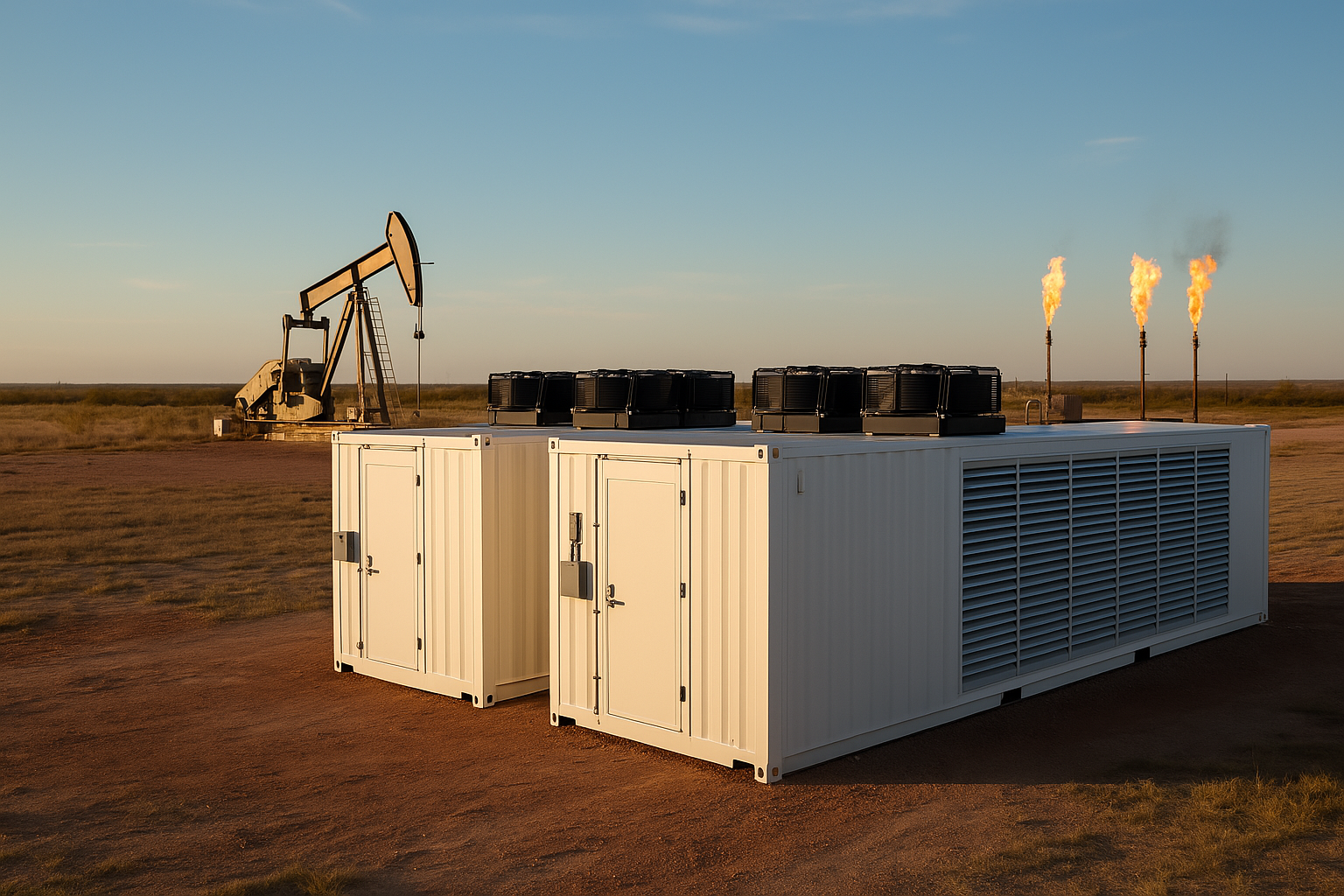
Texas flares more natural gas than any state in America — roughly 2.7 billion cubic meters burned off in 2024 alone. Compute Village turns that waste asset into American compute.
Every conversation about AI now collides with the same wall: power. Inference demand is compounding faster than the grid can expand, and the hyperscale answer — a dedicated substation, a new transmission line, a multi-year utility study — is slow, capital-heavy, and increasingly unavailable. The interconnection queue in much of the country is measured in years.
We took the opposite approach. Instead of asking where can we build a grid big enough for AI, we asked where is there already cheap, wasted energy we can put to work today. The answer kept pointing to one place.
The gas is already here — and it's being wasted
In the Permian Basin and across the Eagle Ford, producers generate enormous volumes of associated gas as a byproduct of pumping crude. Pipelines are constrained and the gas is low-value relative to oil, so a large share is simply flared — burned at the wellhead for nothing. That is one of the largest pools of stranded, penalized, near-zero-cost fuel in North America. Compute Village sites modular data centers directly on it, converting a wasted feedstock into behind-the-meter power, and that power into dedicated AI inference.
ERCOT makes behind-the-meter practical
Texas runs its own grid through ERCOT, largely outside federal jurisdiction. For an operator that wants to generate and consume power on-site — without waiting on a utility to build new capacity — that independence is the difference between deploying in months and deploying in years. And because we never pull from the grid, we don't compete with communities for power or push up their electricity bills.
The talent — and the buildout — are here too
Running infrastructure at a remote wellhead is an operations problem, solved by people who've done it. Texas has the deepest bench of oilfield and energy-operations talent in the country, and the center of gravity for American AI infrastructure is already shifting toward Texas energy. We pursue the same energy logic as the gigawatt developers, at a different altitude: small, repeatable, modular sites sized to the gas at a single field.
A starting point, not an endpoint
Texas is the logical first move, not the whole map. The same playbook — stranded energy, modular deployment, dedicated compute — extends to every basin where power sits idle while AI demand goes unmet. The smartest response isn't to wait for the grid to catch up. It's to build where the power already is.